What is Emotional Intelligence?
Emotional Intelligence (EQ) Characteristics:
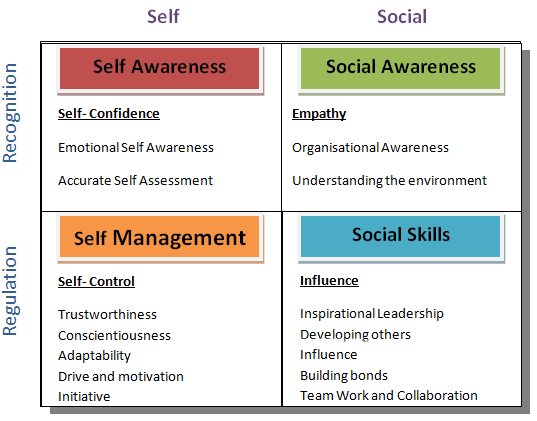
- Self-Awareness
- Empathy
- Handling Relationships
- Attention vs. Impulse
- Intuition & Instinct
- Managing one's inner life
-------------------------------------------------------------
Reasons for EQ in Education and in Society:
- Attention/Memory/Learning: Higher levels of retention
- Decision Making
- Relationship Quality
- Physical & Mental Health
- Performance: Better teamwork & motivation, fewer grievances and morale problems, greater productivity
- Increased creativity & innovation
- Clearer communication & better conflict resolution skills
-------------------------------------------------------------
Behaviors that convey a low EQ:
- Insisting on always being happy or positive in lieu of acknowledging authentic emotions as they arise
- Speaking rather than listening
- Assuming you know how another will respond
- Seeing only either/or options and not the continuum of options
- Not looking up from your smartphone while speaking to others and missing emotional cues while interacting
- Continuously shifting the conversation back to yourself
- Doing the same things over and over and expecting different results
- Dogmatically ascribing to collective "truths" that are outworn and in flux
-------------------------------------------------------------
The intuitive mind is a sacred gift, and the rational mind
a faithful servant.
~ Albert Einstein
-------------------------------------------------------------
--------------------------------------------------------------
Warren Bennis, PhD, Distinguished Professor of Business Administration, USC, one of the preeminent experts on the subject of
leadership, said, “Emotional intelligence, more than any other asset,
more than IQ or technical expertise, is the most important overall
success factor.”
The pendulum has swung too far to one side. We live in times of instability, stress and unrest. Balance seems like a foreign country.
"Our
world and our sense of connection to it has been, for many ages,
defined solely through a lens of outer external meaning. The careers we
choose, the social hierarchical statuses we attain and the truths we play
out uphold the nature of this reality. These personas and roles we fit
into, are mere reflections of masks we put on in order to align with a
collective truth, but for most of us it is not an authentic reflection
of a deeper self." ~ Simon Vorster
The apex of our condition can easily been seen
in the fact that we continue to educate and socialize our children to the left hemisphere of the brain while giving less import to educating the right side which is about the integration of ourselves with the complexity of the world around us. We espouse the ideals of logic over intuition, the pursuit of money over community,
brain over body, industry over nature. This devaluing of the
contributions of the right brain has created a shift in the way we
interact with the world. We have created a society that is completely
reliant on the left hemisphere, on logic and materialism and abstraction - a competitive, specialized, and compartmentalized world. The way we receive information, the language we use, the environment in
which we live, the values of our culture — all of these things influence
the way we use our brains, and this creates a feedback loop from the culture
back to the brain.
There were distinct time periods where society deemed appearing rational, reserved and stoic the appropriate social norm. Expressing emotions was seen as
unattractive, as was living from the gut or the instinctual or intuitive
parts of ourselves. The aristocratic period of the late 18th and early 19th century was one such time-frame. Refined people simply did not show
their feelings until they were in private, if at all. Doing so was
considered undignified and an action of the peasantry and lower classes - of which women were a part. Living masked lives was the norm. Conveying emotion, especially that other than anger or rage which tends to arise from the left-hemisphere of the brain, was seen as weakness. Weakness was not only associated with the absence of physical
strength, it also indicated a lack of moral and social power and was strongly tied to gender. As a general rule, women were perceived as the sensitive sex while men's minds privileged reason and a capacity to
dissect, reflect, and abstract. Women were seen to be highly impressionable
and affected by all kinds of sentiments.
A statement accepted as truth in 1904, “Women are governed by emotion and a sentimental mind, men by intellect and reason.”
Meyers Großes Konversations-Lexikon, 6th ed. (Leipzig: Bibliographisches Institut, 1902–1905), vol. 7 (1904), p. 685.
In the 1830s, it was discovered that emotions could be manipulated to be powerful motivators and homogenizers. Emotions could mobilize citizens to participate in mass movements. Charismatic leaders attempted to streamline the passions they aroused.
Especially when performed in a crowd, those emotions could develop a thrust that went beyond anyone’s control. The mind-frame of the time was to
resuscitate the figure of the male leader and savior, whose charisma largely rested on his ability to speak to the emotions of his followers. For many countries, this abuse of emotions holds sway even today.
Especially when performed in a crowd, those emotions could develop a thrust that went beyond anyone’s control. The mind-frame of the time was to
resuscitate the figure of the male leader and savior, whose charisma largely rested on his ability to speak to the emotions of his followers. For many countries, this abuse of emotions holds sway even today.
Emotions are contagious
for better or for worse.
~ Daniel Goleman, author of Emotional Intelligence: Why it Can Matter More than IQ
When social norms
created the emotional sobriety scenarios of the 1950s, as witnessed in such TV programming as Ozzie and Harriet, Leave it to
Beaver and the Stepford Wives, socialization touted that feelings other than happiness and contentment be swept
under the rug or stored away in closets. How is this authentic? The Norman Rockwell paintings of
the perfect family conveyed how families "should" appear (Rockwell had a
horrific childhood, ie: his penchant for creating the opposite in his
paintings - to heal). Remember the old adage: Appearances can be Deceiving (think Wolf in Sheep's Clothing). In the 50s, how one looked on the outside was extremely important, so much so, that we find the Barbie doll arriving on the scene in 1959.
That masking worked...for awhile. Now the closets
are full to bursting and most are exploding wide-open. Pandora's box has been
opened. Unconscious and unhealed material is rising into our awareness, and as a result, our systems are changing: schools, governments, economics -
even what constitutes "safety" no longer seems viable. We are living in a time of endings and can't see what is emerging on the horizon. It is during times of endings and the void that follows before new beginnings are birthed for each of us to dive deep - to transform outworn patterns - and to follow, as the saying goes the road less traveled. Alongside repressed emotion, the need to better deal
with the unpredictable is present. The left brain hates uncertainty, while the right brain thrives on it. And, as Einstein said, "We can't change the problems of the world with the same thinking that created them." It is time for originality to arise, and it won't be found in preconceived methodologies.
On the flip side, there was an era where the ideal was the harmonious workings of both hemispheres, as life appeared to be in pre-Socratic Athens. During that time, huge strides were made in drama, metaphor, archetypes, myth-making and poetry arising from the right hemisphere, and philosophy, Socratic debate, mathematics and the written language from the left. Integration of polarities is needed if we are to gain firm footing on the ever shifting ground with which we currently find ourselves.
A
young child growing up in an atmosphere where expressing emotion is
considered wrong or weak will suffer. Children, especially those who
are closely connected to the intelligence of their heart and gut and to
intuition - which is most
children - are often socialized out of this kind of intelligence by the
time they leave elementary school. Our foundations for life are
established by our
socialization. The ability to form connections, to bond, and to form
an inward sense of being safe due to self-awareness and inner strength
are not now the focus nor are they cultivated. Psychological maladies result. An over-focus
on technology also lessens our ability to form bonds with others. This
can be witnessed in an over-reliance on technology in lieu of
face-to-face communication.
We
live in a society where the pendulum has swung too far in one
direction. Funding in our schools goes to science, reading, and math
known for being organized, controlled, and logical, whereas music, art
and movement are underfunded or not funded at all. Eventually, this
leads to a lesser ability to retain the very knowledge that our schools must impart. Studies show that the expressive arts play a significant part in binding and storing taught concepts and knowledge for later retrieval. In a healthy, functioning brain, the right hemisphere sees the bigger picture, the context, and sends information
about a situation to the left hemisphere, which “unpacks” the
information using its tools to find clarity, and then it vocalizes the
response, either in thought or expression. However, the left brain's narrow and
focused techniques of grasping information via memorization and
repetition of the parts and pieces is far from adequate when divorced from the bigger picture storage house of the right. Educating for emotional intelligence: connection and relationship-making, understanding metaphors, seeing
things in context and cues grasped from expression that arises from the
right hemisphere is imperative in order to make sense and bring forth original, creative solutions in this rapidly changing world. Teaching to dry methodologies alone is shown to
create boredom, anxiety, and higher stress levels amongst our children
within our public schools. We are plagued with lowered retention, truancy, and are medicating alarming numbers of our children for attention deficit disorder (ADD). As a causal factor, might we not consider that we are not teaching to all learning styles or to only one side of the brain?
In "The Master and His Emissary", Iain McGilchrist speaks to the
divided brain and the making of the Western World. His research shows
that for centuries, we have drifted too far to the left brain. The left brain brings precision, focus, abstraction, rationality, and
fixity. The right brain has a more open view of the world. It provides
context, allowing for
originality, empathy and wisdom by gaining distance from the subject and
grasping the bigger picture. The integration of BOTH sides of the
brain is necessary to better function during shifting times. It is imperative that we merge the fixed, expected and often static attributes of the left
hemisphere with the evolving, interconnected, changing,
mysterious, characteristics of the right. Our intuitive, instinctive,
expressive EQ can no longer be given a static label, boxed or hidden away in a closet. We must give
voice to the attributes of the right hemisphere of the brain and to raising emotional intelligence.
One path
to balance is via the Expressive Arts.